Investigating The Tally Ho – What’s It Got to Say?

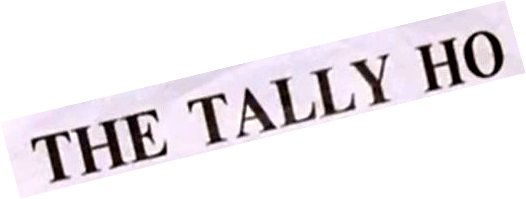
While watching the various episodes of The Prisoner, I’ve noticed that the Village newspaper, “The Tally Ho”, usually has nice clear headlines, but it is difficult to read the stories. Since it would not be reasonable to read while the video is running, I have clipped several examples from individual frames.
First, one must realize that the papers are made up for one-time use in the show, not to be actually read. As such, they are filled with filler text. A close look shows that the vast majority of the text is English, possibly taken from other newspapers, but each line is out of context with the next, paragraphing and word-splitting is off, and there is really no sense. As seen in Figure 1, the job was done quite nicely. It was not a quick cut-and-paste (in the original sense of scissors and glue), but possibly typeset pages were used.

Figure 1
An exception to the nice typesetting is the actual cut-and-paste of a chess puzzle (Figure 2). Taken from the “Checkmate” episode, we see Number Six making annotations on the chess puzzle in his effort to confuse Number Two with a possible conspiracy. When you look at the page, though, the puzzle, its description, and its title are pasted onto a page that is similar to other editions. And it’s not a really good pasting job, either. You can see the edges, and even text extending a bit beyond, since the clipping wasn’t quite the right size.

Figure 2
I was interested in the source of this chess puzzle. It turns out others have been interested, and I found the answer at Chess and The Prisoner. I include their image (Figure 3) of the original puzzle as it appeared in Evening Standard of 9 January 1967. In passing, I wonder if the producers of The Prisoner obtained copyright clearance, or if they thought of the fair use doctrine, or just did their thing without worrying too much.

Figure 3
Many times, television and movie producers will make sure that even such trivial details as newspaper text will look authentic. Too many times sharp viewers have found such discrepancies that are an artifact of creation that take the viewer into the interstices between the fictional work and the methods used to create it.